
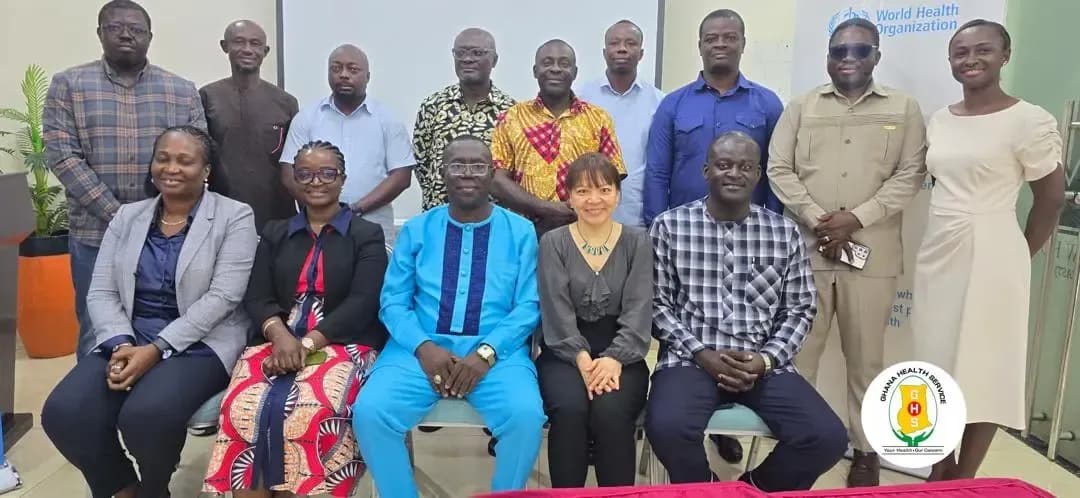
The Ghana Health Service (GHS) has commenced a four-day validation workshop to review and update Ghana's Medical Records Strategy and Operational Guidelines to reflect emerging developments in digital health, data governance, interoperability, cybersecurity and artificial intelligence (AI).
Opening the workshop on behalf of the Director-General of GHS Dr. Samuel Kaba Akoriyea, the Director of Policy, Planning, Monitoring and Evaluation (PPME), Dr. Samuel Kwabena Boakye-Boateng said the revision is necessary because the health information landscape has evolved significantly since the Medical Records Policy was introduced in 2017.
"Our mandate this week is to validate Ghana's Medical Records Strategy and Operational Guidelines so that they are genuinely fit for the environment we now operate in, not the environment of 2017, but the environment of today and of the next decade," he stated.
Dr. Boakye-Boateng acknowledged the contributions of the World Health Organization (WHO) and the United Nations Development Programme (UNDP), noting that their technical support and collaboration, particularly through the medical records gap analysis, have provided a strong foundation for the review process.
He observed that advances in Electronic Medical Records, the growth of DHIMS2, increasing data interoperability, and the emergence of artificial intelligence require updated policies that strengthen data governance, patient privacy, cybersecurity, AI oversight, data quality, equity and implementation frameworks.
"The challenges we are addressing, which are, absent AI oversight, weak data quality standards, fragile consent models and inequitable access, are not abstract governance problems. They affect real people seeking care in our facilities every day. Our patients deserve policy that protects them. Our health workers deserve guidelines that support them."
Speaking on behalf of the United Nations Development Programme (UNDP), Ms. Toko Reikam, Project Management Specialist at UNDP Ghana, reaffirmed the organisation's commitment to supporting Ghana's digital health transformation.
"By addressing potential risks and ensuring human security, artificial intelligence can contribute to improving health outcomes in Ghana. UNDP, jointly with WHO Ghana, is happy to join the Ghana Health Service to revise this critical document," she said.
The workshop brings together regional health managers, medical records professionals, digital health experts and development partners to validate recommendations across six priority areas, with the outcomes expected to inform a modern, secure, rights-based and interoperable medical records governance framework for Ghana's health sector.
Dr. Boakye-Boateng officially declared the workshop open and urged participants to ensure their deliberations produce practical, evidence-based guidelines that will strengthen health information management and safeguard patient data for generations to come.
The validation meeting is being facilitated by Dr. Salamatu Attah Nangtoma, Dep. Director, IME and Mr. Collins Agyenim Boateng, Dep.Director, Plans and Budget, Mr. Hammond Sakwaah, Dep. Director, ICT, with technical support from Mr. Dominic Atweam of WHO Ghana office and Ms. Yoko Reikam from UNDP Ghana office.