
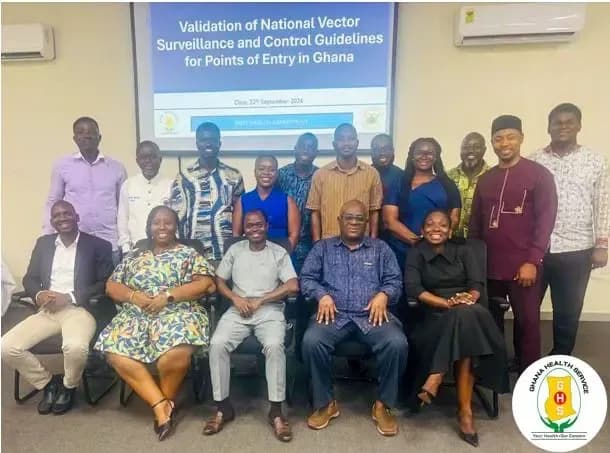
The Port Health Department of the Ghana Health Service with support from the US Centers for Disease Control and Prevention (US CDC), has held a national stakeholder validation meeting on the draft National Vector Surveillance and Control Guidelines for Points of Entry (PoEs) in Ghana.
The Guidelines are being developed to provide a standardised, risk-based and coordinated framework for the prevention, detection, surveillance and control of vectors of public health importance at the country’s Points of Entry.
Held at the new GHS Headquarters in Pantang, the meeting brought together key stakeholders to critically review the draft for technical accuracy, clarity and completeness, assess the practicality of the proposed approaches to risk assessment, surveillance, inspection, vector control and emergency response, and identify gaps and areas requiring further refinement. The deliberations also sought to build consensus on key amendments and recommendations to strengthen the Guidelines ahead of finalization.
Presenting an overview of the draft Vector Surveillance and Control Guidelines (VSCG), Deputy Director of Port Health, Dr. Alphonsus Chantiwuni Nindow, explained that the Guidelines were being developed in recognition of the role of Ghana’s Points of Entry as interfaces for substantial international movement of people, conveyances and cargo, which could create opportunities for the introduction and spread of vectors. He noted that the draft also sought to address identified gaps in vector surveillance, human resources, infrastructure, laboratory support and emergency response capacity at Points of Entry.
Dr. Nindow said the Guidelines were intended to translate relevant national and international requirements into practical and standardised procedures for Port Health and other stakeholders, while providing a common, risk-based framework that could be adapted to the context of individual Points of Entry.
He explained that the draft provides a standardised approach to vector identification, surveillance and monitoring, as well as risk assessment, risk categorization, surveillance indicators, thresholds and vector-free zone requirements. It also provides guidance on the inspection and control of vectors associated with conveyances, cargo, containers, baggage and Point of Entry environments, and outlines measures for the detection, notification, investigation and response to unusual vector-related events, including invasive vectors and outbreaks.
According to Dr. Nindow, the Guidelines would apply to all Points of Entry in Ghana and cover vector surveillance, conveyance and cargo inspection, environmental inspection within Points of Entry and their 400-metre perimeter, vector control, data management and reporting, governance, and capacity strengthening.
The development of the Guidelines was informed by a baseline assessment conducted at three selected Points of Entry; the Accra International Airport, Tema Port and Aflao Ground Crossing, and subsequent technical review by a Technical Working Group (TWG). The validation meeting therefore served as an important stage in the development process, allowing stakeholders to further assess the draft’s technical soundness, operational relevance and applicability to the Ghanaian context.
The meeting brought together representatives from the National Malaria Elimination Programme (NMEP), National Public Health Reference Laboratory (NPHRL), Noguchi Memorial Institute for Medical Research (NMIMR), School of Public Health/Ghana Field Epidemiology and Laboratory Training Programme (GFELTP), Veterinary Services Directorate, Ghana Immigration Service, Ghana Revenue Authority (Customs Division), Food and Drugs Authority, Ministry of Local Government (Environmental Health and Sanitation Directorate), Plant Protection and Regulatory Services Directorate, Ghana Airport Company Limited and Ghana Ports and Harbours Authority. Key development partners in attendance included the US CDC, World Health Organization and Jhpiego Ghana.